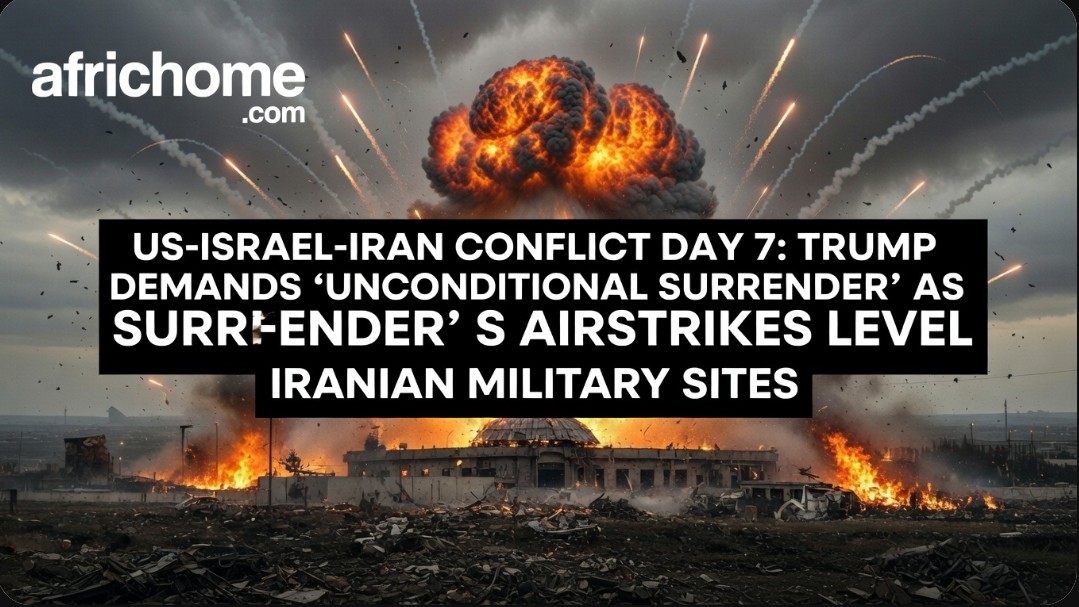
TEHRAN/TEL AVIV — The military confrontation between the United States, Israel, and Iran entered its second week on March 7, 2026, marked by a massive escalation in aerial bombardment and a hardening of diplomatic stances. As the conflict widens into a regional war, global energy markets are reeling from the disruption of critical shipping lanes.
Trump Pushes for Regime Change Following Khamenei Demise.

U.S. President Donald Trump hasa signaled a “no-compromise” stance, repeatedly taking to Truth social to demand the unconditional surrender of the Iranian government. Following reports that Supreme Leader Ayatollah Ali Khamenei was killed in earlier precision strikes, Trump stated that the U.S. intends to oversee the selection of a “great and acceptable” future leader for the nation.
White House officials projected that the “main phase” of the air campaign would last another four to six weeks, asserting that munition stockpiles remain sufficient for a prolonged offensive.
IDF And U.S. Forces Target Iran’s Missile ‘Backbone’
Overnight operations into March 7 saw the heaviest bombardment to date. The Israeli Defense Forces (IDF) and U.S. Central Command launched synchronized strikes across Tehran, Qom, Isfahan, and Karaj.
- Infrastructure Damage: The IDF claims to have struck over 400 targets in a 24-hour window.
- Naval & Air Losses: U.S. intelligence reports that 60% of Iran’s ballistic missile launchers have been neutralized, while a significant portion of the Iranian Navy has been sunk in the Persian Gulf.
- Command Centers: Strikes focused on degrading the Islamic Revolutionary Guard Corps (IRGC) command-and-control hierarchy.
Regional Spillover: Missiles Over Tel Aviv and the Gulf
Iran has retaliated with multi-vector attacks involving ballistic missiles and “suicide” drones. Air raid sirens paralyzed Tel Aviv and Jerusalem today as interceptors lit up the sky. While many projectiles were intercepted by Israel’s multi-layered defense or fell in uninhabited areas of Jordan, the psychological impact remains high.
Beyond Israel, the conflict has bled into neighboring states: - Saudi Arabia & UAE: Intercepted drones aimed at oil fields and military bases.
- Iraq & Syria: U.S. facilities near Iraqi airports and Syrian sites reported drone impacts.
- Lebanon: Israel struck 80 Hezbollah positions, while the Lebanese Armed Forces attempted to enforce a government ban on the group’s military activity.
- The Human and Economic Toll
The humanitarian crisis is mounting. Iranian officials report over 1,300 civilian deaths, while casualties in Israel continue to rise from falling shrapnel and direct hits near Jerusalem. - Global Market Impact:
The Strait of Hormuz remains a primary flashpoint. Iranian attempts to obstruct the waterway, combined with attacks on energy infrastructure, have caused global oil prices to skyrocket. Shipping insurance rates have reached historic highs, threatening a global inflationary spike.
“The U.S. and Israel recognize no red lines,” stated Iran’s UN Ambassador, who accused the coalition of targeting civilian infrastructure under the guise of military necessity.